The AI Paradox: Navigating the Environmental Cost of Intelligence
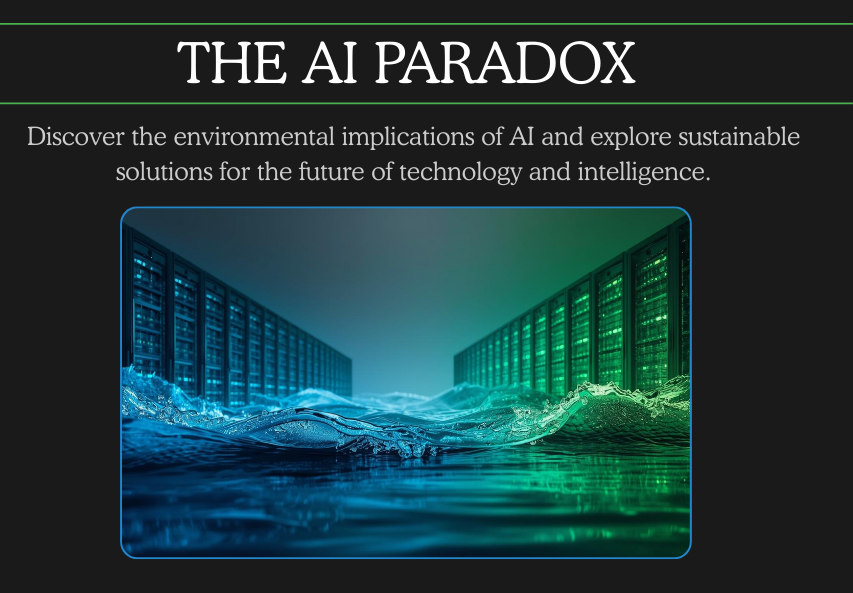
Date: January 5, 2026 Topic: Green AI, Sustainability, and Data Center Governance Word Count: Approx. 800 words.
Abstract
By 2026, Artificial Intelligence has ceased to be a novelty; it is the operating system of our global economy. However, as AI models shift from training to mass deployment ("inference"), their environmental footprint has grown exponentially. This article explores the concept of "Green AI," analyzing the hidden toll of hyperscale data centers from energy consumption to water usage and outlines the necessary shift toward sustainable computing architectures and regulatory compliance.
1. The Invisible Smokestacks of the Digital Age
The environmental footprint of AI is physical, tangible, and rapidly growing. It lives in "the cloud," which is comprised of vast global networks of hyperscale data centers. These facilities are the factories of the 21st century, consuming massive amounts of natural resources.
In the current landscape, environmental damage is driven by two primary factors: Energy Consumption and Water Usage.
1.1 The Shift from Training to Inference
Historically, the primary environmental concern was the energy required to train massive models a significant but one-time expenditure. Today, the challenge has evolved into the era of Inference.
Every time an AI agent answers a query, processes an invoice, or recognizes a face, it performs "inference." While a single inference uses negligible power, billions of autonomous agents performing trillions of daily tasks create a relentless, baseload energy demand. According to the International Energy Agency (IEA), data centers now account for a significant percentage of global electricity use, with projections suggesting this could double by 2030 if left unchecked.
1.2 The Thirst of Processing Centers
Data centers generate immense heat. To keep thousands of high-performance GPUs operational, they require massive cooling infrastructure. While air cooling is an option, it is energy-intensive; therefore, many facilities rely on water cooling towers.
An average mid-sized data center consumes hundreds of thousands of gallons of potable water daily. In water-scarce regions from the American Southwest to the Middle East this creates a direct resource conflict between technological progress and local agricultural needs.
2. The Principles of Green AI
"Green AI" is a holistic approach to mitigating this damage. It requires rethinking the AI lifecycle across three pillars:
2.1 Algorithmic Efficiency (Small is Beautiful)
For years, the industry trend was "Red AI" the pursuit of state-of-the-art accuracy by increasing model size regardless of cost. Green AI dictates a pivot toward Small Language Models (SLMs). Specialized models that are smaller and faster require exponentially less energy for inference than general-purpose Large Language Models (LLMs).
2.2 The Hardware Revolution
The industry is moving away from general-purpose Graphics Processing Units (GPUs) toward specialized hardware designed specifically for AI workloads, such as Neuromorphic Computing. These chips mimic the human brain's efficiency, performing calculations using a fraction of the electricity required by traditional silicon architecture.
2.3 Decoupling from Fossil Fuels
The most immediate mitigation strategy is the energy source. Tech giants are increasingly becoming the world's largest corporate buyers of renewable energy (PPA). Furthermore, there is a growing trend toward locating data centers in colder climates to reduce cooling loads naturally.
3. Governance and Regulation
Sustainability in AI is no longer optional; it is a regulatory requirement.
CSRD (Corporate Sustainability Reporting Directive): In the EU and complying jurisdictions, companies must now report "Scope 3" emissions, which includes the carbon footprint of their cloud service providers and AI vendors.
ISO 42001: This international standard for AI Management Systems places a heavy emphasis on the responsible use of AI, including sustainability and resource management.
Conclusion
The trajectory of AI development in its current form is unsustainable. If computing power demand continues to outpace efficiency gains, we risk negating the environmental benefits AI promises to deliver. The future of the industry relies on Carbon-Aware Computing software that runs when and where energy is cleanest. We cannot afford to let the digital revolution degrade the physical world it relies upon.
Terminologies & Glossary
Green AI: AI research and development that treats carbon emissions and energy consumption as primary evaluation metrics, alongside accuracy.
Red AI: AI research that prioritizes state-of-the-art results (accuracy) through massive computational power, often disregarding energy costs.
Inference: The phase where a trained AI model is put to work to make predictions or generate content based on new data. This is distinct from "Training."
FLOPs (Floating Point Operations): A measure of computer performance and energy usage. Estimating the total FLOPs required for a model is a standard way to calculate its carbon footprint.
PUE (Power Usage Effectiveness): A metric used to determine the energy efficiency of a data center. It is the ratio of total facility energy to the energy specifically delivered to IT equipment.
Scope 3 Emissions: Indirect emissions that occur in the value chain of the reporting company (e.g., the emissions produced by the data center hosting your AI software).
Neuromorphic Computing: A method of computer engineering in which elements of a computer are modeled after systems in the human brain and nervous system, offering high energy efficiency.
Hyperscale Data Center: Massive business-critical facilities designed to support robust, scalable applications, typically exceeding 5,000 servers and 10,000 sq. ft.
References & Citations
Schwartz, R., Dodge, J., Smith, N. A., & Etzioni, O. (2020).Green AI. Allen Institute for Artificial Intelligence. (This foundational paper defined the terms Green AI vs. Red AI).
International Energy Agency (IEA). (2024).Electricity 2024: Analysis and forecast to 2026. (Provides data on the rising energy demand of data centers).
Strubell, E., Ganesh, A., & McCallum, A. (2019).Energy and Policy Considerations for Deep Learning in NLP. University of Massachusetts Amherst. (Famous study highlighting the carbon footprint of training large models).
ISO/IEC 42001:2023.Information technology — Artificial intelligence — Management system. International Organization for Standardization.
Patterson, D., et al. (2021).Carbon Emissions and Large Neural Network Training. Google Research / UC Berkeley.
European Union.Corporate Sustainability Reporting Directive (CSRD). (Directive (EU) 2022/2464).